
If you read a clear, biblically accurate book on the subject of suffering, even if the writer has not personally suffered greatly, you’d consider it a valuable contribution.
But if such a book were written by a man who has suffered greatly, who shared his personal struggles with loss and depression in the context of dealing thoroughly with biblical truth, you’d give it five stars on Amazon and buy copies for friends who hurt.
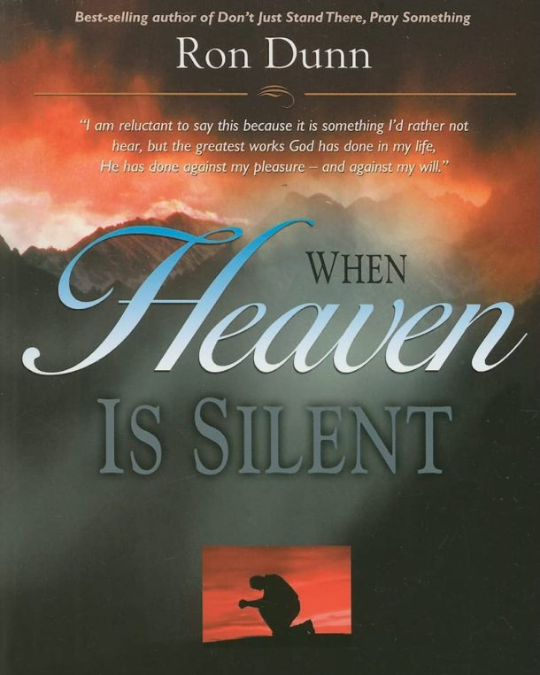
That’s what I did after reading When Heaven Is Silent: How God Ministers to Us Through the Challenges of Life.
Ron Dunn was a pastor and conference speaker who died in 2001 at age 64. His sermon tapes, which were widely distributed in the 1970s and beyond, ministered to me as a young man. But I didn’t read When Heaven Is Silent until this year. Ron walked through the valley of the shadow of death. His 18-year-old son committed suicide on Thanksgiving Day, 1975. For 10 years afterward, Ron experienced bouts of severe depression. His book is still in print 32 years after its release, which testifies to its impact.
In the late 1970s, several years after his son’s suicide, I heard a sermon tape in which Dunn said, “You will never know Jesus is all you need until He is all you have left.”
When Heaven Is Silent explains why he said that.
Characteristics of the Book
Saturated in Scripture: Dunn gleans truth from the stories of Jacob, Job, Joseph, Jeremiah and Christ himself. He analyzes texts from numerous books of the Bible, including Genesis, Isaiah, Jeremiah, Psalms, the Gospels and Romans. The author’s experience isn’t the source of truth: God’s Word is! He illustrates how Scripture informs his challenging experiences, not how his pain birthed those truths.
Transparency: He describes his struggles with God’s painful providence. You discover how the Bible truths he shares first taught and sustained him.
Resourceful: Though God’s Word was his primary resource for dealing with his loss, Ron also read numerous books and articles by people who had suffered significantly or written on the topic. The list of people he quotes includes Augustine, Pascal, C. S. Lewis, Paul Tournier, Helmut Thielicke, Richard Foster, Cynthia Swindoll, John White, J. I. Packer, Amy Carmichael and Henri Nouwen.
Clear and Understandable: He communicates in print in the same way he preached. He’s down-to-earth, easy to follow, and avoids highfalutin words that only Bible scholars would understand.
Three Vital Takeaways
Link Between Romans 8:28 and 8:29
Romans 8: 28 is a well-known verse: “And we know that God causes all things to work together for good to those who love God, to those who are called according to His purpose.”
Ron’s exegesis of the verse focuses on the redemptive outcome Paul cited. “When the Bible says all things work together for good, it means that all things work together to accomplish God’s purpose. God’s purpose is the good.” Then Ron identified the broad purpose in verse 29: “Those whom He foreknew, He also predestined to become conformed to the image of His Son.”
Dunn concludes, “Even now, in this present life with all its afflictions, the ‘all things’ can serve to refine me and shape me so I will much more resemble my Savior. It is through the ‘all things’ of earthly experience that God works in us a Christ-like compassion for those who hurt, Christ-like love for enemies, and a Christ-like submission to the Father’s will.”
Our Toughest Battles
The author uses excerpts from Bible texts featuring Jacob, Jeremiah and Job to point out that when suffering strikes, our toughest battles aren’t with Satan, other people or difficult circumstances. Our primary struggles are with God!
Job wrestled with an angel. God was the aggressor in that encounter. Jeremiah’s lament about his mistreatment questions God, who had called him to his difficult ministry. He cried to God, “You have deceived me…You have overcome me and prevailed… The word of the Lord has resulted in reproach and derision all day long” (Jeremiah 20:7-8). Job’s severe misfortunes occurred because God gave Satan a green light. The book shows his active protest directed to God, not to the devil. Dunn said, “Sometimes it is easier to say no to the devil than to say yes to God.”
Reading Dunn’s commentary on this concept will be worth the price of the book. You’ll discover that affliction always poses a test of God’s character.
The Inevitable Question: Why?
Ron explains in detail why asking, “Why did this happen, Lord?” is the wrong question. In his case, no matter what insight “Why?” brought to him concerning his son’s suicide, no possible reason satisfied him.
Ron said, “The real issue is not where the suffering came from, but what are we going to do with it. The why of suffering is not the ultimate issue. The ultimate issue is how we are to respond to that suffering.” He suggests shifting away from “Why me?” to “What now?”
Ron wrote, “‘Why me?’ afflicts us with tunnel vision, making it impossible to see anything but the ‘unfairness’ of our predicament. ‘What now?’ breaks the trance of self-pity.”
I can’t write well enough to explain how difficult the process was as Ron learned these lessons. He doesn’t offer superficial, simple answers. Yet his blend of biblical exegesis and personal story offers sustenance for sufferers.
I’ll put a cap on this review with this statement from Ron: “The greatest works God has done in my life, He has done against my pleasure–and against my will.”
________
You can purchase When Heaven Is Silent at Amazon Books and other booksellers.





Terry – thank you for sharing the content of this book. Your conclusion is a hard truth we need to hear. I’m reading a book about Adonirum Judson and the suffering that bore fruit is amazing. And he went through a lot.
Thanks, Maria, Hope you and your loved ones are well.
Thank you Terry, as always!
Appreciate your words, Terri!
I appreciate this. Thank you!
You are most welcome, Suzanne!