
What hard choices should be made before you become terminally ill or die unexpectedly?
Why is it good stewardship and a loving thing to do to “live with the end in mind”?
What are the components of an effective end-of-life plan that will ease the burden on your loved ones and give you peace of mind as your death approaches?
What difference should a robust faith in Christ make as you navigate the final chapters of this life?
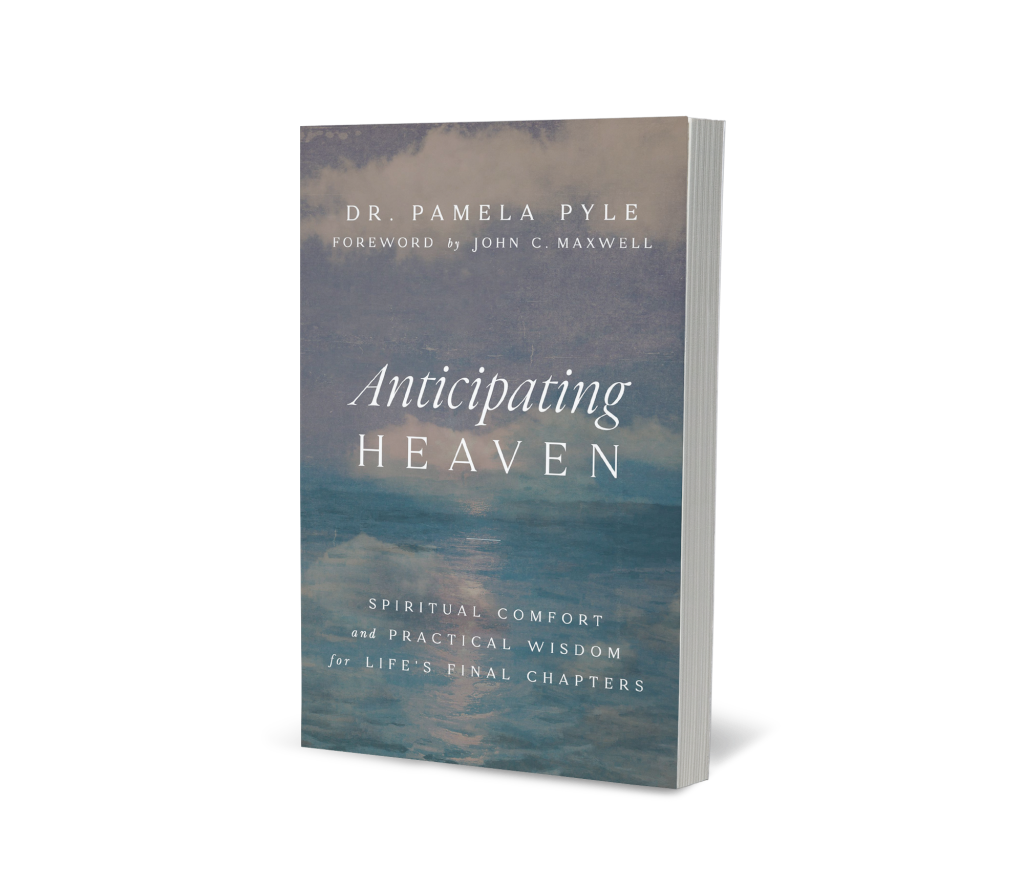
Those are a few of the questions addressed in Dr. Pamela Pyle’s book, Anticipating Heaven: Spiritual Comfort and Practical Wisdom for Life’s Final Chapters (Thomas Nelson, 2025).
Practical Issues
The first half of the book delves deeply and in detail on mundane, yet necessary issues that accompany physical decline. She offers questions to ask for choosing the right physician, choosing a health care proxy, responding to a cancer diagnosis, patient care in the ICU (Intensive Care Unit), transitioning to hospice care and preparing a “Final Wishes” document before it is needed. She advocates preparing now an ACP document (Advance Care Plan). Pamela explains and illustrates from her own ACP document the areas that should be covered. She shows us how to prepare an ACP; she doesn’t just tell us to do it. The author goes far beyond the kind of documents many of us have prepared: Living Will, Power of Attorney and instructions for asset distribution.
Her rationale for urging advance preparation is the brevity and uncertainty of life. She calls our ability to control when and how we die an illusion. She alludes to the prayer in Psalm 90:12: “So teach us to number our days, that we may present to You a heart of wisdom.” Wisdom is acknowledging the inevitability of death, then backing up and preparing for it accordingly. In a comprehensive manner, Pamela offers concrete suggestions for the final chapters of life. Her experience as a physician and her vibrant Christian faith show us how to prepare for death, as well as for eternity.
“The truth is,” she insists, “if you don’t prepare for the unexpected, some level of chaos will inevitably ensue.”
Biblical Perspective
Though Scripture dots the pages of the practical section of her book, the second half primarily focuses on Scripture and its implications. I appreciated these remarks:
“The strength of faith is fully known when it is tested. Faith provides a place to focus our pain, questions, confusion and even anger. We cannot be angry at God and not believe in Him. Our Father God can receive each of our emotions as we cry out for answers.”
“Perhaps you will fulfill God’s purposes for your life because of your suffering. Suffering gives you a stage, and pain becomes a megaphone…Your suffering can be a catalyst for growth. It can result in a deeper relationship with God as you become dependent on his strength, not yours. This dependency allows you to comfort others as God comforts you.”
Her research on the value of prayer when suffering revealed that even when prayers don’t result in healing, the practice nonetheless offers benefits: improved physical, psychological, social and spiritual well-being. Pamela emphasizes and illustrates through stories how God redeems illness and other forms of suffering.
You’ll read a clear communication of the gospel, centered on why Jesus died on the cross. She concludes this discussion with these words: “The cross represents the death we deserve and reminds us of the cost that was paid…Without the cross, there would be no resurrection, and without resurrection, we could not anticipate heaven.”
Boldly, she asks the reader to consider these questions: “Am I prepared to die? Am I confident of my destination?”
Story Time
Anticipating Heaven would be well worth its price if she didn’t include stories of dying people and their loved ones. Yet every chapter includes one or more lengthy anecdotes that illustrate the medical issues and biblical perspectives she conveys. Her stories offer a warm human touch and make reading much more interesting. I especially appreciate the story of survivors of conflict in Rwanda, where colonialism and identity politics resulted in horrific killing sprees during which over a million Tutsis were slaughtered.
In Rwanda, she befriended a man named Blessed, a scarred genocide survivor whose parents were murdered. He tells how joyful he is since he learned to love again and to forgive the murderers. This isn’t her only story showing how God redeems suffering, but it’s the one that resonated most with me.
Helpful Resources
In addition to numerous resource references within chapters, Pamela provides a 35-page “Further Practical Resources” at the end of the book. The list includes “A Guide to Documents and Advanced Planning,” guidelines for determining when you or a loved one needs assistance with decision-making, and a “Dictionary of Serious Illness Terms” that you may encounter at the hospital.
Her website includes a blog, “Hope for Every Season” (drpamela.com). The book and website offer compassionate guidance through faith-centered conversations on suffering, grief and death.
Procrastinator’s Epitaph
As I read the book I kept thinking of the “Procrastinator’s Epitaph.”
At the top of the tombstone these words are chiseled: Here Lies A Man Who Was Always “Going to….” Then along the bottom you read, Now He’s Gone.
May God’s Spirit nudge every reader to heed her suggestions while there is still time.





Terry- thank you for highlighting this book. Sounds like every one with aging parents who then themselves will find themselves in this situation can use!